A Shift in the Ecosystem of Creativity
How Generative AI is Reshaping The Definitions, Dynamics, and Economics of Creative Arts
by Saurav Mohapatra (sm@flyinghogmonkey.com)
Version: 1.0.0 (2025-10-02)
Estimated read time: 6 minutes
https://flyinghogmonkey.com/shift
For the past year, the conversation around Generative AI has been a deafening roar of utopian promise and dystopian fear. We’ve been told it is either the dawn of a new Renaissance or the twilight of human creativity. But beneath the hype, a more nuanced and fundamental transformation is taking place. It’s not about replacement; it’s about relocation.
The Old World: Where Craft Was King
To understand the magnitude of this, we must first appreciate the old world and the complexities and challenges of mastering a craft. A painter spent decades perfecting their brushstrokes and understanding of light. A composer studied music theory for years to arrange a symphony. A filmmaker needed a crew, expensive equipment, and immense technical knowledge to translate a script to the screen.
For centuries, the creative ecosystem has operated on a clear axis. On one side, you had the supply: the artist, the musician, the filmmaker. This was the domain of craft, where years of dedicated practice were required to master a skill, develop a style, and bring a vision to life. On the other side, you had the demand: the patron, the client, the audience. Their role was to provide constraints - a budget, a brief, a set of tastes - and to respond to the finished work by adopting or rejecting it.
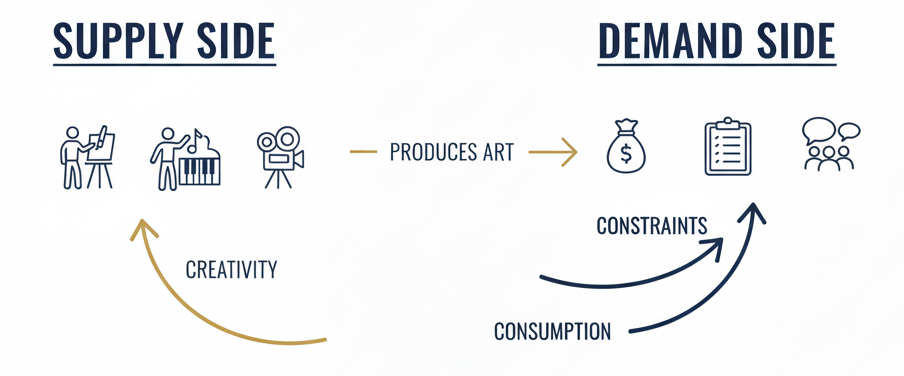
In this model, creativity was an emergent property of deep, specialized labor. The evolution of patterns, themes, and structures happened within the artist’s studio, a process of trial and error invisible to the outside world. The consumer only saw the final product.
The Tectonic Shift: AI as a Universal Lever
The fundamental shift of Generative AI is that it is moving the barycenter, the center of mass, of this entire ecosystem. It is pulling the power of creation away from the exclusive domain of the supply side and democratizing the intricacies of craft and iteration, bringing them closer to the demand side than ever before.
This is not the end of art; it is the radical redistribution of the means of its production.
Generative AI acts as a universal lever, prying open the gates of the old fortress. It achieves this by democratizing the two core components of creation that were once the exclusive purview of the artist: craft and iteration.
1. The Democratization of Craft
Tools like Midjourney, Google's Imagen[1], Suno[2], and Sora[3] act as translators between intent and execution. The user’s role shifts from craftsman to creative director.
2. The Democratization of Iteration
The once-costly process of experimentation is now virtually free. This rapid, frictionless iteration brings the evolutionary process of creation directly into the hands of the user.
From Construction to Expression: A New Creative Workflow
"Generative AI is the ultimate flood fill tool... It’s a paradigm shift from perfecting construction to maximizing expression."
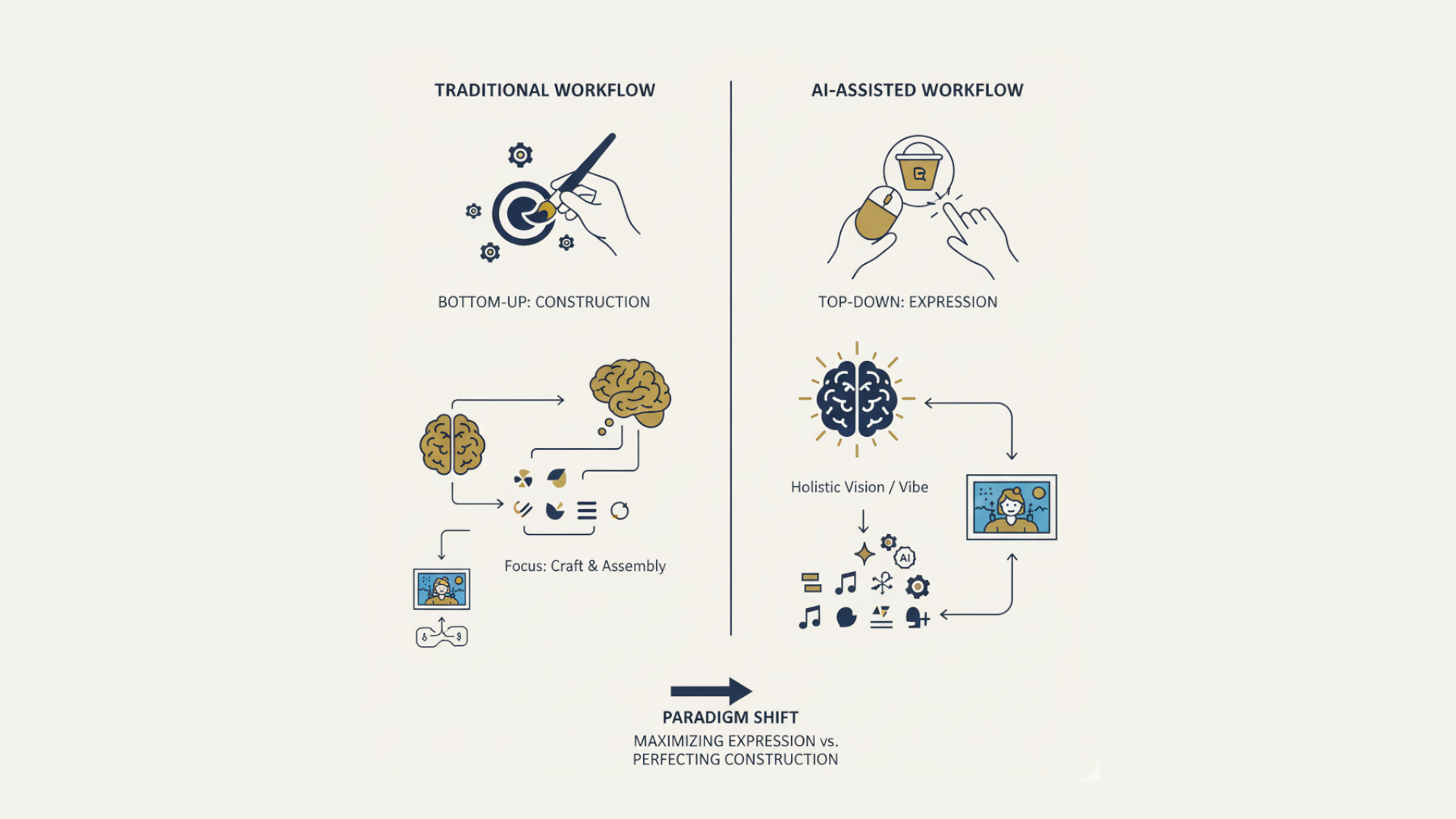
To grasp the essence of this change, consider a simple analogy: filling an area with color. A watercolor artist's focus is consumed by the construction of the color field. In a digital paint program, a user selects the "flood fill" tool and clicks. The cognitive load of *how* to fill the space is eliminated. Generative AI is this flood fill tool, but for melody, imagery, and narrative. This enables a fundamental inversion of the creative process. Traditionally, artists worked "bottom-up." Now, they can work "top-down," starting with the holistic vision - the feel, the vibe, the core emotion.
The Ghost in the Machine
Navigating the Uncanny Valley with Tilly and Xania
Of course, this shift has not been without its growing pains. The "uncanny valley" of creativity is a real phenomenon, as seen in the backlash against the "AI-generated actress" Tilly Norwood[5]. Her debut felt hollow because it presented AI as a substitute for human performance. In stark contrast, the commercially successful AI singer Xania Monet[6] works because it’s a symbiotic project. A human artist, Telisha "Nikki" Jones, writes the lyrics from her own experience, using the AI as a sophisticated instrument to give her words a voice.
How This Article Was Written
It feels only right to turn the lens of this analysis inward. This article began with a thesis scribbled on paper (during an idle moment at lunchtime). I then collaborated with Gemini to structure the arguments into a skeleton flow, which I typed out in Google doc. Then, I did one more pass with Gemini to polish the prose.
But the AI-assisted text felt impersonal, so I undertook a significant rewrite, using the draft as a scaffold to re-inject my own voice and flow.
Once the text was ready, I used a combination of Google Imagen and Midjourney to create the hero images and infographics, tweaking the images manually in GIMP to match the palette and mood of the piece. Finally, I used Gemini Canvas to create a HTML5 single page site to host the text.
Exploring the New Model
As a tangible extension of this philosophy, I also embarked on a personal experiment: the YouTube account "Kampa Kola presents LOVE BY CHANCE". The goal was to produce an album of Hindi film-inspired love songs. I wrote all the lyrics (using some assists from ChatGPT to convert the text to Devanagari script for better pronunciation down the line, as well as fix some meter/width issues), and then used Suno V5 to transform these lyrics into fully arranged songs. I did some minor mixing and reprocessing of the generated stems as post processing.
The end result was better than I had anticipated, yet is not quite at the level of something I could envision a passionate and talented creator (one well versed in the craft) producing.
Redefining Ownership: The Ethical Frontier
This experiment immediately surfaces a complex ethical dimension. From the outset, I have been careful never to claim that I "composed" the music for "LOVE BY CHANCE”, always referring to it as "generated." This distinction feels critical. But the journey doesn't end there. The intent now is to use this generated music as a "scratch" track, a sophisticated musical blueprint. The next step is to bring this blueprint to actual musicians and singers to finish the album.
This process allows me, a pure writer and filmmaker, to bridge a gap where I lacked the foundational craft of musical composition. But, it also forces us to confront challenging questions that will define the next era of creativity.
When a human musician re-records and embellishes an AI-generated melody that was based on my lyrics, who owns the final composition? Who can claim to be the artist? This workflow will test our traditional notions of ownership and creative drive.
The answer to questions like this will perhaps plague us for the foreseeable future. But I'm optimistic that the sheer power of this moment will help us find the right answer. There is value in debating this and engaging in discourse over the nuances, rather than simply resisting this shift due to pure sentimental reasons.
Forging a Human-AI Symbiosis: The Artist as Conductor
In navigating this, our definitions of art and craft are going to change fundamentally. The "art" may become the initial vision and the final flourish - the creative direction, while the "craft" will be a fluid collaboration between algorithms and human performers - iterating over the atomics of structure and execution.
The distinction between Tilly and Xania, and the process behind this article, is the key to the future. The most compelling creative work in the age of AI will not come from autonomous algorithms, but from a seamless blend of the human and the machine. In this new paradigm, the AI becomes the world's most capable instrument, and the human becomes the conductor. The artist's value shifts from technical execution to their taste, vision, and storytelling ability.
The barycenter has shifted, placing unprecedented creative power in the hands of many, but the need for a human soul at the heart of the work has never been more clear.
Art is not dead; it has simply been handed a powerful new instrument (albeit one that can fundamentally redefine the dynamics of the ecosystem).
Now, we all get to learn how to play.
About the author
Saurav is a technologist, writer, filmmaker, and artist based in the San Francisco Bay Area. He has spent most of his life in the twilight zone between art and technology. His experiments with Bollywood-inspired music with modern generative AI tools can be found at https://youtube.com/@kampakolamusic
Listen to a NotebookLM summary "podcast" (12 mins)